QR codes in Africa

Small vendors and large banks across Africa now settle payments, share menus, and verify products with a single printed square, cutting the cost of building card networks or paper systems from scratch.
Key Takeaways
- Mobile money platforms like M-Pesa and MTN MoMo added QR scanning specifically because agent networks couldn't keep pace with demand for card-free payment.
- Urban shoppers in Kenya and Ethiopia increasingly choose QR-based payment over cash at physical stores because it feels safer, per Market Data Forecast research.
- Low-data connectivity in many regions means codes linking to lightweight pages load faster than ones pointing to media-heavy sites.
- A single static sticker printed for a season won't survive price changes, so vendors running promotions need a dynamic code they can redirect without reprinting.
A market trader in Lagos used to keep a mobile money agent on speed dial just to collect payment from anyone who didn't have exact change. A commuter in Nairobi used to queue at a ticket window for a paper transit pass that could be lost or torn.
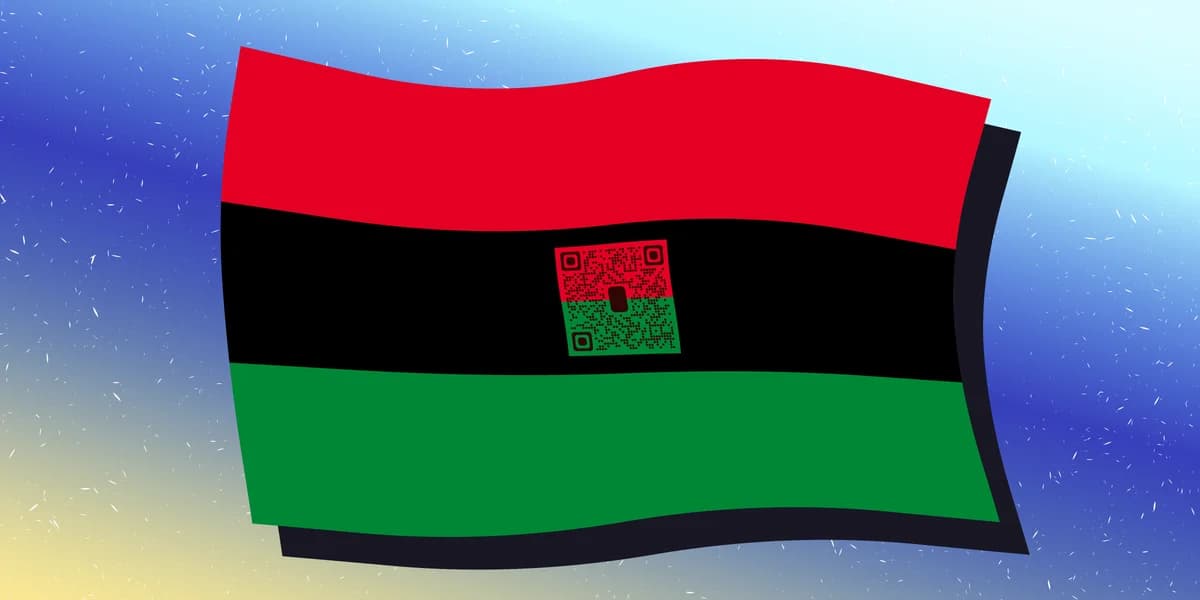
That leap is why QR code creation in the Middle East and North Africa region jumped 66% year-over-year in the first half of 2023, according to the Bitly QR Code Trends Report, a trend detailed further in our QR code facts by country roundup. Payment providers followed the same logic: national QR payment schemes in the Africa and Middle East region are projected to process $68 billion by 2024, per Juniper Research. The pattern repeats across sectors — transit, retail, agriculture, and government services all found it cheaper to print a code than to install a terminal.
Where QR codes are already working across Africa
The use cases aren't theoretical — they're already running at scale in specific industries, each solving a distinct infrastructure gap.
Mobile money and retail payment
Kenya's M-Pesa, Ghana's mobile money ecosystem, and Nigeria's fintech apps all added merchant QR scanning so a shop owner can accept payment without owning a card reader. The customer opens their banking app, scans the code taped to the counter, and confirms an amount that's already correct because the merchant generated a fixed-value code for that transaction, a distinction worth understanding through our guide on static vs dynamic QR codes.
Public transit and ride-hailing
Bus rapid transit systems in cities like Dar es Salaam and Lagos use QR tickets scanned at turnstiles, replacing paper passes that riders used to lose or damage in the rain. Ride-hailing and boda-boda operators print codes on helmets or jackets so passengers can verify a driver's registration before getting on.
Agriculture and supply chain verification
Cocoa and coffee cooperatives in West Africa attach codes to shipment crates so buyers overseas can trace a batch back to the specific farm and harvest date, which matters for fair-trade certification and premium pricing, a use case similar to the traceability functions covered in our QR codes on food packaging guide. Seed and fertilizer companies also use codes to help farmers verify they haven't purchased a counterfeit product.
Small business marketing and menus
Restaurants and cafes in Cape Town, Accra, and Kigali print codes on table tents to replace laminated paper menus, similar to the pattern covered in our QR code menu guide. Market vendors selling crafts or produce increasingly add a code linking to a WhatsApp catalog, since WhatsApp QR codes let a buyer message the seller directly without typing a phone number.
Tips for building a QR code that works in African markets
Connectivity, device variety, and language differences all shape what makes a code actually usable on the ground, not just theoretically scannable.
Link to a text-first landing page rather than a video or image gallery, since 3G and patchy 4G coverage in rural areas make heavy pages time out before they load.
Test your code on a range of budget Android phones, not just the latest iPhone, since camera quality and native scanning support vary widely across the devices most common in the region.
Offer content in at least two languages — a national language plus English or French — since a single-language landing page loses buyers who scan but can't read the result.
Print codes at a minimum of 3cm square on outdoor market signage, since fading ink and dusty conditions reduce contrast faster than in climate-controlled retail environments.
Build codes with the free QR code generator so you can test a link before committing to a print run for market stalls or transit passes.
Frequently Asked Questions
Do QR codes work without a smartphone in rural Africa?
No — scanning requires at least a basic smartphone with a camera app or scanner, which is why mobile money providers pair QR payment options with USSD-based alternatives for feature phone users in areas with lower smartphone penetration.
Why did mobile money apps add QR scanning instead of just using phone numbers?
Typing a phone number for every transaction is slower and more error-prone than scanning, especially for merchants processing dozens of small transactions a day; a scanned code also removes the risk of sending money to a mistyped number.
Are QR payment codes in Africa safe to use?
Reputable banking and mobile money apps generate codes tied to a verified merchant account, but the same phishing risks that exist everywhere apply here too — check our QR code safety guide before scanning an unfamiliar sticker at an informal stall.
Which industries in Africa use QR codes the most right now?
Mobile payments, public transit ticketing, and agricultural supply chain tracing currently show the heaviest adoption, with retail marketing and event ticketing growing quickly behind them.
Related Guides
Ready to create your QR code?
Generate custom QR codes in seconds - free and easy to use.
Create Free QR Code →